
The Hemo-Caribbean affair: when Haitians' blood was sold under Duvalier
By NAGO News
2 min read
In the early 1970s, under the Duvalier dictatorship, a Port-au-Prince company bought blood plasma from poor Haitians and resold it to pharmaceutical companies in the United States. It was called Hemo-Caribbean. The affair became a scandal in 1972 that reached the U.S. Congress.
Founded by Miami businessman Joseph B. Gorinstein, Hemo-Caribbean operated in Port-au-Prince in 1971 and 1972. Donors, often very poor, were paid about $3. The plasma was frozen and flown to the United States, where laboratories turned it into products such as albumin and gamma globulin.
Luckner Cambronne's role
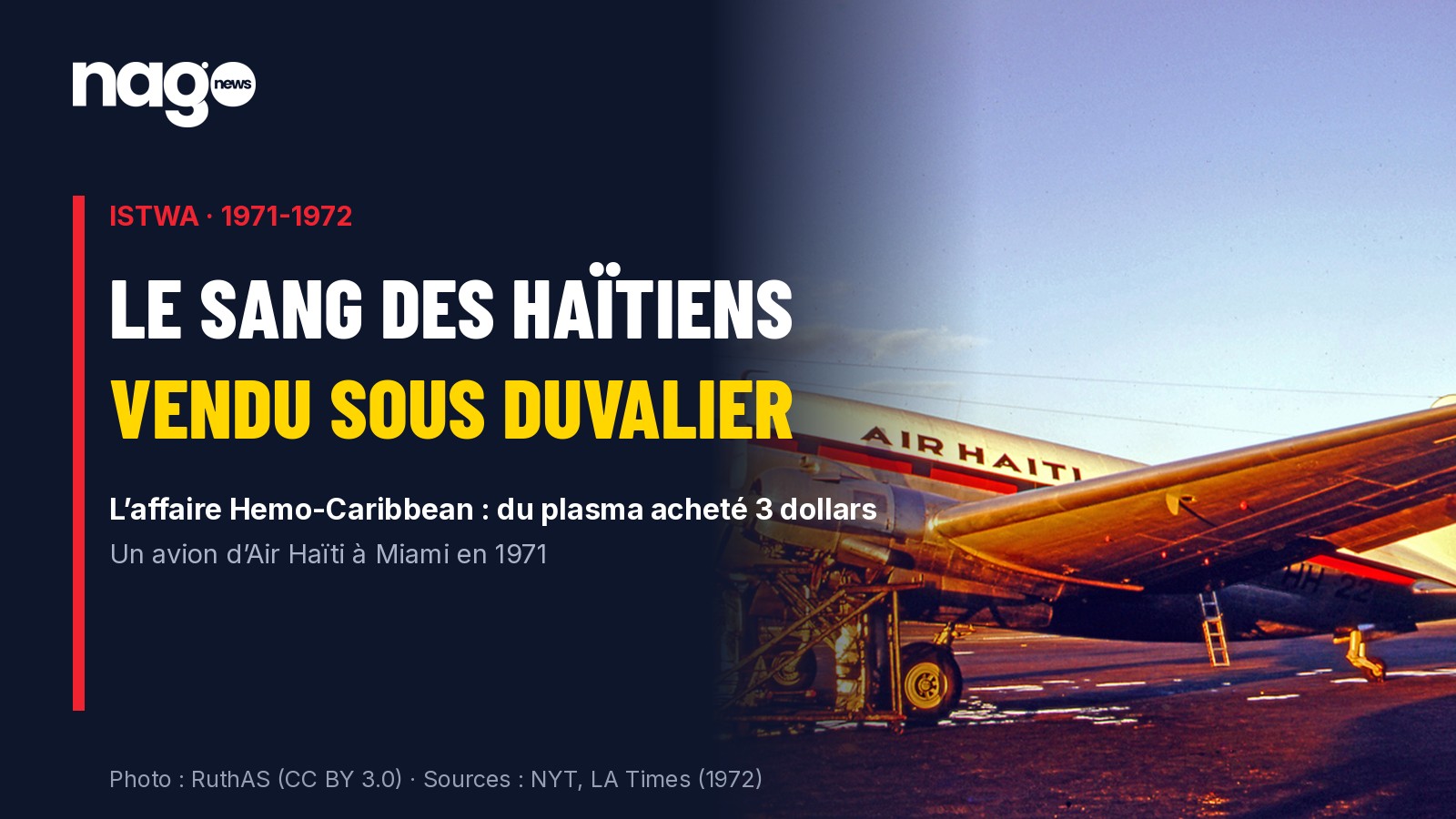
Interior and Defense Minister Luckner Cambronne, the strongman of Jean-Claude Duvalier's government, was reported to have an interest in the company. His airline, Air Haiti, flew the frozen plasma to the United States, according to press reports at the time. The affair earned him the nickname "vampire of the Caribbean."
According to 1972 press reports, the center collected about 350 liters of plasma a day and planned to add 500 more. The plasma also went to European laboratories, according to the journal Hektoen International.
The New York Times investigation
The scandal broke in late January 1972, when The New York Times published reporter Richard Severo's investigation, "Impoverished Haitians Sell Plasma for Use in the U.S." The Los Angeles Times also covered the story. The reports raised the exploitation of poverty, the donors' health and the lack of oversight of the international blood trade. The U.S. Congress took up the issue. The International Red Cross took up the "trade in human blood" in Geneva in September 1972. Under the weight of the bad publicity, Hemo-Caribbean eventually closed.
Decades later, Canadian physician and researcher Jacques Pépin, in his book "The Origins of AIDS," suggested that collection centers of this kind, with poor hygiene, may have helped spread HIV in Haiti. That theory remains debated.
Half a century on, the Hemo-Caribbean affair remains one of the starkest examples of how poverty, political power and foreign commercial interests came together at the expense of Haiti's most vulnerable people.
Watch and share
The reel and the cards for social media.
Videos
Watch now.
Wikipedia, « Luckner Cambronne »
NAGO News, « Il y a 98 ans, le 23 octobre 1928, Luckner Cambronne naissait »
Comments 0