
Eight dead, in a report nobody read
By La rédaction de NAGO
8 min read
"The General Directorate of Civil Protection carries out the functions of coordination, situation monitoring and public information, with an emphasis on informing populations exposed to risk." That is Civil Protection describing itself, in its situation report No. 3, published on Tuesday 27 October at 4.30 p.m. On its website it flies a motto: "Pwoteksyon Sivil se nou tout" — civil protection is all of us.
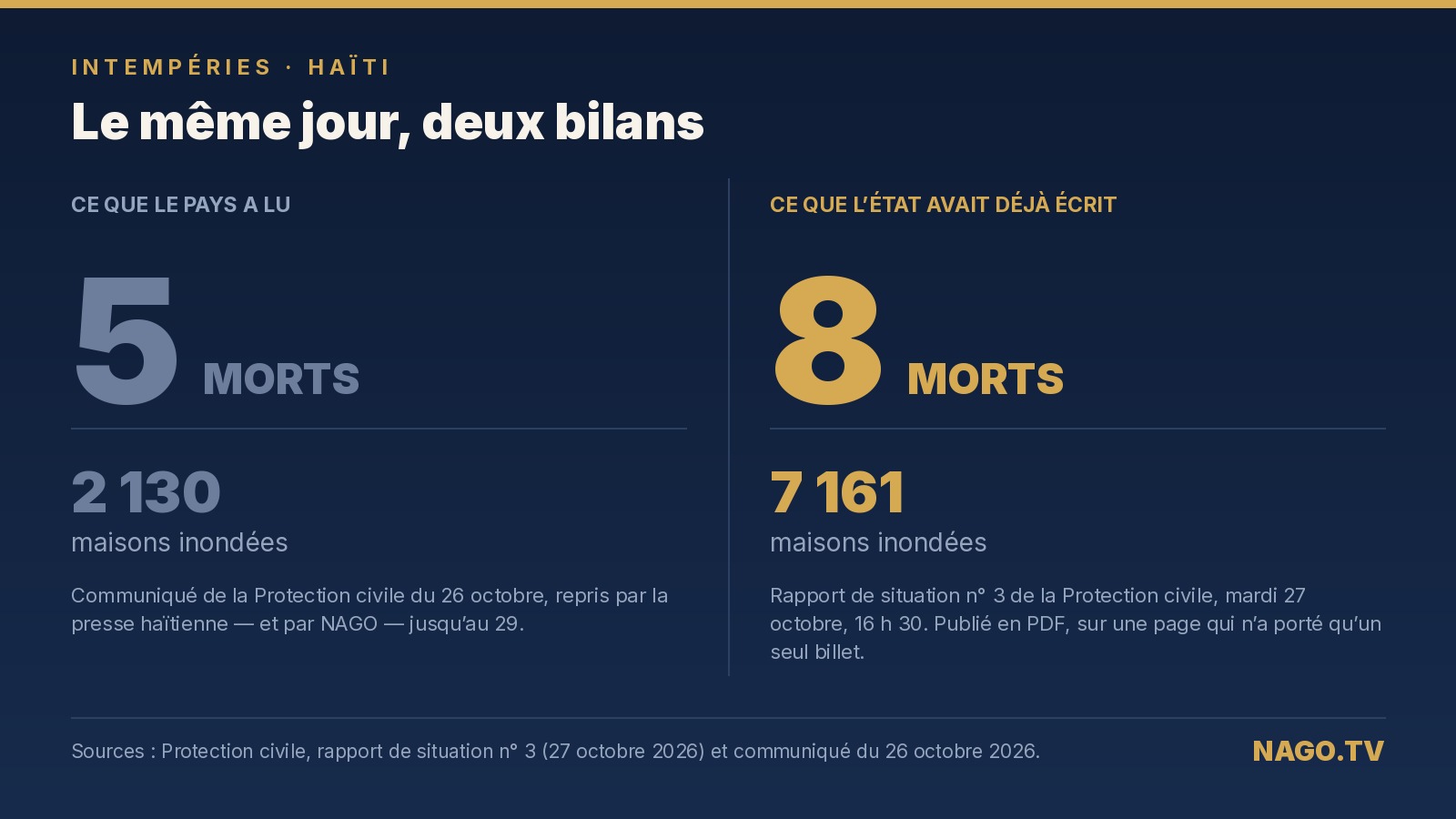
Let us take the agency at its word. That report of 27 October is a good document. It gives eight dead, forty injured, five missing, 11,884 affected families and 7,161 houses flooded across twenty-seven communes. It breaks the figures down by department. It costs out the needs down to the last hygiene kit. It names its own constraints. And in a footnote it corrects an error in its previous report: 798 houses destroyed in the West were in fact ten, "owing to a technical error." An administration that puts its own arithmetic right in the middle of a crisis is doing exactly what we ask of it.
Meanwhile, the country was reading something else. For three days the Haitian press repeated the communiqué of 26 October: four or five dead, 2,130 houses flooded, twenty-one communes. We are no exception, and that is the hardest part of this to write. Our own article, posted on the evening of 27 October, reported five dead and 2,130 houses. It also reported two fishermen missing, when all eight of the Abricots fishermen had already returned home alive. We corrected it on 29 October, after opening the report.
Because opening it was required. The real toll was not on the page: it was inside a 774-kilobyte PDF, to be downloaded, beneath a single post. Across the whole rain episode, from 24 to 29 October, the Civil Protection website published one article. To learn how many Haitians had died, you had to click, download and open. A toll you download is not a toll you publish.
The networks can be pleaded in mitigation, and the report pleads them itself: mobile telephony and internet were "severely disrupted, or unavailable" in several communes of Grand'Anse and the South. That is true, and it explains why the field figures rose slowly — 300 houses in the South on 26 October, 3,332 on the 27th, 7,087 on the 28th. But honesty has to run to the end, and the rest does not favour us. Civil Protection publishes better today than it used to. In 2016 and in 2021, its reports reached the public only through international humanitarian websites, days late; it now issues them itself, in French and Creole, on its own site and through a WhatsApp channel, in near-real time. The document of 27 October was therefore available that very evening. It was not read. The blame shifts, and it falls first on the press.
Still, things must be said in their proper order. That report, even read by everyone, would have saved neither Chanaïca Macilien, fifteen, swept away by the Codas ravine at Gwo Trou, nor Woodmayley Dieurismé, two and a half, swept away by the Brodequin river at Kapiyas. What would have protected them is not published: it is built. And it was not built.
In 2015, a study commissioned by the Ministry of Agriculture put it plainly: "The Ravine du Sud watershed, with the city of Cayes at its outlet, shows the greatest economic impact from flooding." The Haitian state had therefore identified, in writing and by its own hand, the costliest basin in the country. Six years earlier, in 2009, it had obtained a thirty-million-dollar grant from the Inter-American Development Bank to protect three watersheds against flooding: Cavaillon, Grande Rivière du Nord and Ravine du Sud. Four riverbank protection structures were built: one at Maniche, on the Cavaillon, and three on the Artibonite, a basin that was not among the three announced. Not one metre on the Ravine du Sud.
A second source of funding was aimed at exactly that gap. Norway had committed a further fourteen million dollars to strengthen the banks of those same three basins. A review commissioned by Norwegian development cooperation found in 2013 that the Ministry of Agriculture had never launched the programme and that none of the money had been disbursed. After two years of inaction it was reallocated: nine million to Macaya Park, five million to energy.
And when the money did appear in the national budget, it was not spent. In its own accounts for the 2016-2017 financial year, the Ministry of Agriculture enters twenty million gourdes under the line "riverbank protection works," spends none of it, and writes the annotation itself: "No works carried out." The neighbouring line, "watershed development," is executed at 8.6%, with this note: "No physical works."
The result can be read in the report of 27 October, in Civil Protection's own words: "the bank protection works built along the Ravine du Sud, particularly in the La Créole and K Larco sectors, suffered major damage, including the collapse of several sections." And it becomes easier to understand why, once you look at what the state grants the institution it charges with protecting us from the water: 164,926,650 gourdes for the current financial year — 0.048% of the national budget, and not one gourde of investment.
Let us be fair. Civil Protection did its job with what it is given. In the South it activated its operations centres at three levels and mobilised 107 people; seven shelters took in 237 families. In Nippes, eight shelters housed 402 people and 283 of them were fed. In Grand'Anse, the departmental centre held daily meetings with the mayors of nine communes out of fifteen, and the police carried out a forced evacuation at Gébeau when residents refused to leave a bridge during the flood. We found no trace of concealment: on the contrary, this administration publishes its mistakes.
And it has improved where nobody is looking. In October 2025, ahead of Hurricane Melissa, 2.2 million people received warning messages and 47,465 received cash before the storm arrived, thanks to two million dollars released in advance. That capability did not exist in 2016, when Matthew killed 546 people. Its budget execution rose from 33.9% in 2021-2022 to 99.5% in 2024-2025: it can no longer be accused of failing to spend what it is given. And since August 2025 its brigade volunteers have at last had health insurance, six years after one of its own directors called that absence "inadmissible." At Corail, during that same week of rain, the re-profiling of the ravine Congo, carried out by the Economic and Social Assistance Fund under CECI supervision, protected the inhabitants and their property. These works function when they are built.
What this institution never publishes is itself. The National Disaster Risk Management Plan 2019-2030 requires annual and six-monthly progress reports; seven years on, not one has appeared. The national emergency response plan displayed on its own website is a document from December 2001, revised in 2009, stamped "working document," with an unsigned agreement page. On that site, the sections for contingency plans, laws and regulations, reports and statistics, and the national emergency plan are all empty. An administration able to announce within hours that eight people have died ought to be able to say whether, over ten years, fewer are dying. Ours cannot, because nobody has ever required it to.
So we ask for four things. That Civil Protection publish the progress reports its own national plan has required of it since 2019, and an annual account stating how many people were warned, evacuated and assisted — without which no one will ever know whether it is improving. That it issue its situation reports as text, on a feed radio stations can read on air, rather than as files to be downloaded. That the Ministry of Agriculture and the Inter-American Development Bank publish the final accounting of the 2009 programme — what was built, where, for how much — and that the ministry say what became of the works planned for the Ravine du Sud. And that the next budget give Civil Protection an investment line, however modest, because an institution with no investment credit can build nothing. Haitians at home and in the diaspora should demand these documents, as they demand accounts from candidates.
We also make a commitment of our own. NAGO will from now on read the situation reports at source, rather than yesterday's communiqué.
On Tuesday 27 October at 4.30 p.m., the Haitian state knew that eight people were dead. It had written it down. It did not say it.
Right of reply: NAGO will publish, without delay and on the same terms, any response from the General Directorate of Civil Protection, the Ministry of Agriculture, the Inter-American Development Bank or any institution named in this editorial, with supporting documents, sent via nago.tv/contact. We will correct any fact shown to be inaccurate.
Videos
Watch now.
Reporting by Direction générale de la protection civile, « Rapport de situation #3 » (27 octobre 2026)
MARNDR, « Rapport bilan annuel 2016-2017 » (novembre 2017)
Ministère de l'Économie et des Finances, Budget général de l'exercice 2025-2026
HaitiLibre, « Zapping » — le reprofilage de la ravine Congo à Corail (28 octobre 2026)
By La rédaction de NAGO
Comments 0