
Paraguay: removed and arrested, Santiago Peña moved to a military base after the Ueno Bank collapse
By NAGO News
5 min read
Update, November 7: the Senate unanimously removed Santiago Peña on Friday night. Arrested right after, the former president was moved at dawn on Saturday to a military base in Asunción for his safety. Pedro Alliana has succeeded him.
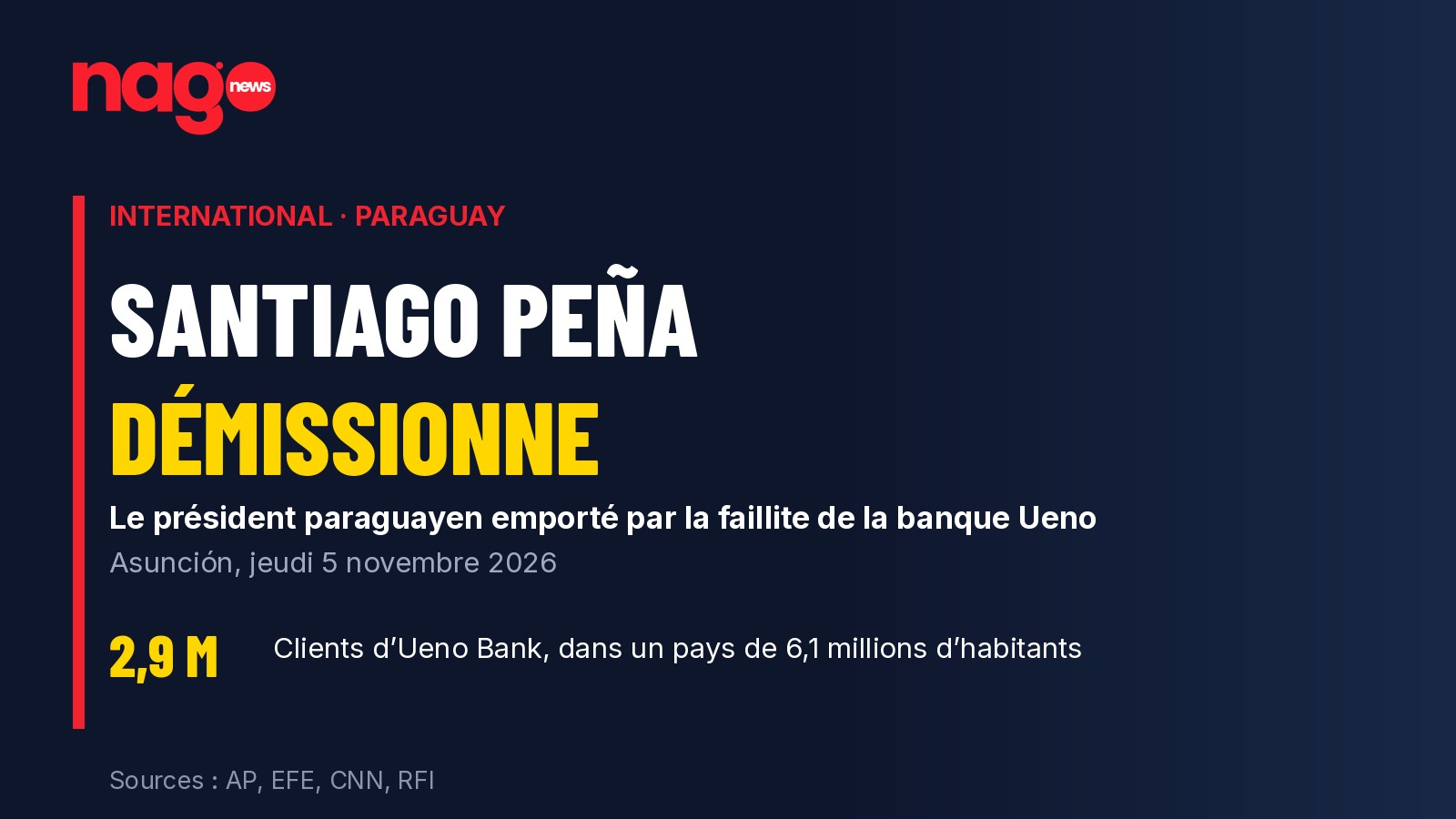
Paraguay's president, Santiago Peña, announced his resignation on Thursday, November 5, 2026, as the Chamber of Deputies was debating whether to open impeachment proceedings against him. He is accused of a conflict of interest over Ueno Bank, a digital bank with which he had close ties and which the Central Bank of Paraguay took over on Tuesday over solvency problems.
"I have made the decision to submit my resignation from the presidency of the Republic," Peña said in a video posted on X, saying he was acting for the country's stability and to preserve its democratic institutions. He apologized but did not take responsibility for the crisis, according to AP. Congress must now decide whether to accept the resignation.
Millions of savers locked out
Since the central bank stepped in, all Ueno Bank branches have been closed and its operations frozen. The bank had 2.9 million customers in a country of 6.1 million people, according to the EFE news agency. It also held about $850 million in public funds, including some $380 million belonging to the Social Security Institute (IPS), the state pension and health fund, according to AP. Savers protesting in Asunción were dispersed by police.
Eight of the bank's executives have been arrested, including its chairman Juan Manuel Gustale and its CEO Federico Miguel Vázquez, until recently a business partner of Peña's, according to AP. The president had been a shareholder in Ueno Holding, EFE notes. On Wednesday he signed a law allowing part of the deposits to be repaid quickly, up to about $19,800 per customer, and named a new central bank governor after the resignation of Carlos Carvallo, a former head of Financiera Ueno.
Elected in April 2023 with 42.74% of the vote, Peña, 47, was due to stay in office until 2028. His mentor, former president Horacio Cartes, withdrew his support on Thursday and backed the impeachment process, according to EFE.
The Senate will have the final say
Hours after the resignation was announced, the Chamber of Deputies nonetheless voted unanimously to open impeachment proceedings against Peña, the Argentine daily Ámbito and the EFE news agency report. The case now goes to the Senate, which will have the final say and must also decide whether the president's departure makes the proceedings moot, according to Ámbito.
Deputies did, however, reject a request to impeach Vice President Pedro Alliana, by 48 votes to 30, according to EFE and N Digital. The vote clears his path to succeed Peña, EFE reports. For the succession to take effect, Congress must still formally accept the resignation, La Nación notes.
Resignation not accepted, Senate trial under way
Congress did not accept Santiago Peña's resignation, so he formally remains president, El Universal reports. The Senate opened the impeachment trial against him on Thursday night for "poor performance of his duties," according to Excélsior. On Friday, November 6, senators overwhelmingly rejected his request for 72 hours to prepare his defense and summoned him to appear. Peña did not show up and was represented by his lawyers, according to Ámbito and ABC Color. His lawyers argue that his resignation makes the trial moot.
The Senate then unanimously admitted, 41 to 0, all the evidence presented by the prosecuting committee, La Gaceta reports. Senate President Basilio Núñez said he has the votes to remove the president. No verdict had been reached by Friday evening.
Removed, arrested, then moved to a military base
On the evening of Friday, November 6, the Senate removed Santiago Peña by a unanimous vote of all 44 senators present, three days after the Central Bank took over Ueno Bank. Lawmakers accuse him of using his influence to steer hundreds of millions of dollars in public funds to the bank. He has always denied any wrongdoing.
Prosecutors immediately ordered his arrest. Peña was placed under house arrest that evening, according to early reports. "I will submit to the process," he told prosecutor Elena Fiore. The charges at this stage are breach of trust, influence peddling and administration for his own benefit, according to prosecutor Christian Benítez. The same order covers former Central Bank president Carlos Carvallo. Vice President Pedro Alliana, 52, a former governor of Ñeembucú, was sworn in the same evening to finish the term, which runs until August 2028.
During the night, dozens of protesters gathered outside his home in Asunción demanding that he be sent to prison. Police fired rubber bullets and vehicles in the security detail were attacked. Judging his safety at risk, the authorities moved him at dawn on Saturday to the Presidential Escort Regiment, a military unit in the capital, according to Elonce and Al Jazeera. He was summoned before prosecutors on Saturday at 11 a.m. A judge must then set the measures and the final place of his detention.
Since the case began, 27 people have been charged and six bank executives are in pretrial detention according to press reports. Repayments began on Thursday, starting with depositors holding up to 10 million guaraníes (about $1,600).
This article was corrected on November 7, 2026.
Videos
Watch now.
Reporting by El Día (AP), « Presidente de Paraguay renuncia tras colapso bancario e inminente juicio político » (5 November 2026)
Al Jazeera English (vidéo), Santiago Peña transféré dans une base militaire (7 November 2026)
La Nación, « Tras ser destituido por el Senado, Santiago Peña fue detenido en su domicilio »
Comments 0